Best Sourdough Starter Kit: The ~$40 of Gear You Actually Need (2026)
Search "sourdough starter kit" and you'll find $60–90 gift boxes stuffed with silicone mats, scoring guides, and bread bombs you'll never touch. Here's the uncomfortable truth from every experienced baker's kitchen: sourdough runs on five tools, four of them cost less than $20 each, and the most important one is a $12 scale. This page ranks exactly what to buy, in the order your money should leave your wallet — so you can spend the savings on better flour.
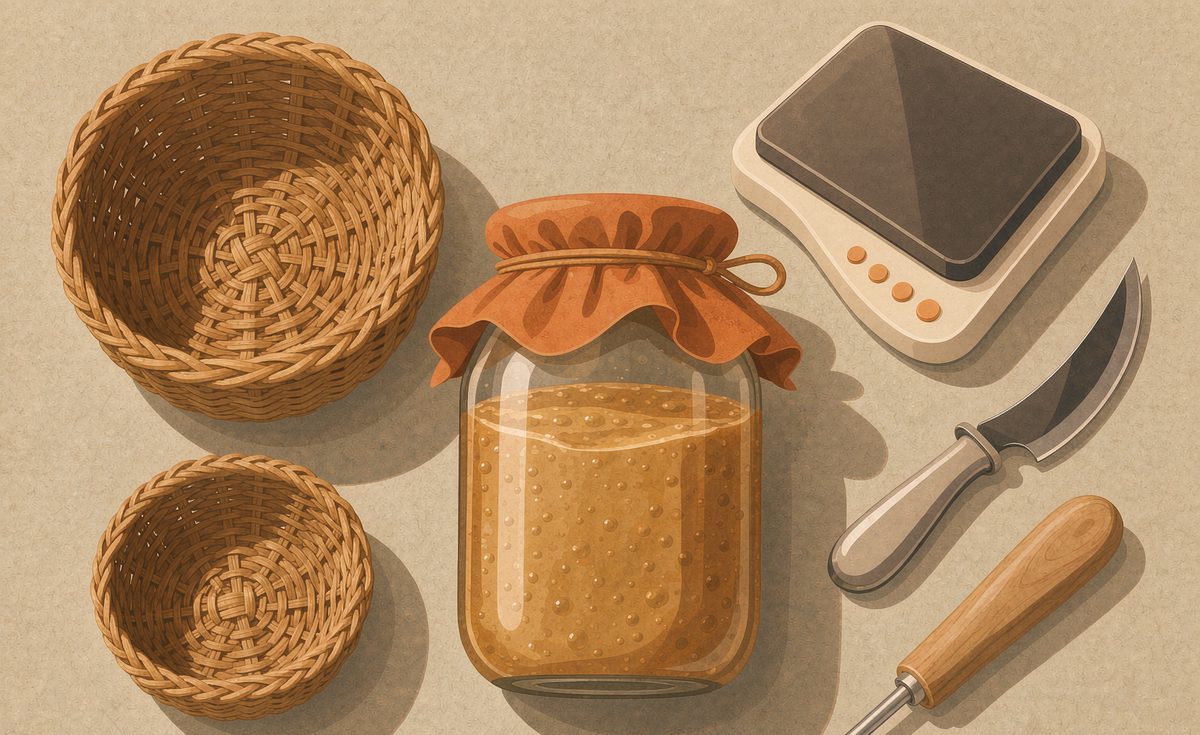
The kit at a glance
| Tool | Why it matters | Budget pick | Upgrade pick |
|---|---|---|---|
| Digital scale | The non-negotiable — sourdough is percentages | Amazon Basics (~$12) | Escali Primo (~$30) |
| Instant-read thermometer | Dough temp drives fermentation speed | ThermoPro TP03 (~$15) | ThermoWorks Lavatools (~$35) |
| Banneton basket | Shapes and supports the wet final rise | 9-inch round w/ liner (~$14) | Breadtopia oval (~$28) |
| Scoring blade (lame) | Controls how the loaf expands | Box of razor blades (~$6) | WireMonkey UFO lame (~$30) |
| Starter jar | Houses your culture safely | Wide-mouth quart jar (~$8) | Weck fermentation jar (~$18) |
1. Digital scale — where every gram of success starts
Amazon Basics Digital Kitchen Scale / Escali Primo
If you take one thing from this page: volume measurements quietly ruin sourdough. A "cup" of flour can weigh 120g or 150g depending on scoop technique, which drags your hydration across a 20% swing — the difference between dough and soup. A scale that reads in 1-gram increments fixes this forever. The Amazon Basics unit is accurate and costs lunch money; the Escali Primo adds a smoother platform and proven long-term reliability if you bake weekly.
Watch out for: any scale without a grams mode, and "0.1oz precision" bathroom-style scales — bread math needs grams.
Check scales on Amazon2. Instant-read thermometer — the fermentation GPS
ThermoPro TP03
Dough temperature, not the clock, tells you when bulk fermentation is done — 78°F dough rises in 4 hours where 68°F dough takes 7. A 2-second thermometer turns recipe timing from guesswork into data: check your water temp, check your dough temp, adjust. It also verifies your dutch oven preheat, which matters more than most guides admit.
Watch out for: slow probes. The TP03 reads in ~2–3 seconds; cheaper clones take 10+, and in a 475°F oven you'll burn your hand waiting.
Check thermometers on Amazon3. Banneton basket — the shape of the thing
9-Inch Round Banneton with Liner
High-hydration sourdough dough is too wet to hold its shape through the final proof on a bare counter. A floured banneton cradles it, wicks surface moisture, and imprints the spiral that makes home loaves look professional. The 9-inch round fits a standard 900–1000g boule — the size most recipes and most dutch ovens are built around.
Watch out for: your first three loaves. A bowl + floured tea towel works fine while you're still learning to shape — upgrade to the banneton when shaping stops being the hard part.
Check bannetons on Amazon4. Scoring blade — control the crack
Razor Blades (or a lame)
Scoring isn't decoration — it's steering. The blade tells the loaf where to expand; unscored loaves burst at their weakest point. A bare razor blade held in hand scores better than most cheap plastic lames, which is why a $6 box of blades is the honest starter pick. When you score weekly and care about patterns, the WireMonkey UFO lame is the community favorite that actually earns its price.
Watch out for: dull blades. Swap every few loaves; a dragging blade tears wet dough instead of cutting it.
Check lames on Amazon5. Starter jar — house your culture properly
Wide-Mouth Quart Jar (750ml–1L)
Your starter is a live culture producing CO2, which means the one rule is: never airtight. A wide-mouth quart jar with the lid resting loosely on top is the classic setup — wide mouth for feeding and scraping, glass so you can read the rise marks. Rubber-banded rise markers (or marks on tape) turn feeding into a visible growth chart.
Watch out for: screwing the lid on. Sealed jars of active starter have cracked. Loose lid, always.
Check jars on AmazonWhat you don't need (yet)
- Proofing mats, dough whisks, silicone steaming bands. Each solves a problem you won't have in your first month. Buy when a specific problem appears.
- A stand mixer. Sourdough is developed by folds over time, not kneading power. If you want a machine in your bread life, a good bread machine does more for less counter space.
- "Complete" gift-box kits. You're paying $40 for packaging around $20 of gear you'd have chosen differently. Build the kit above instead.
Frequently asked questions
What do I actually need to start sourdough?
Scale, thermometer, banneton, scoring blade, starter jar — about $40–60 total. Everything else is optional until a specific problem shows up.
Is a scale really necessary?
Yes — flour volume measurements swing 20%, which wrecks hydration ratios. A $12 gram scale is the highest-leverage purchase in bread baking.
Do I need a banneton?
For wet doughs, eventually. A floured towel-lined bowl works for the first few loaves; get the 9-inch banneton when you're shaping confidently and baking weekly.
Can the starter jar be sealed?
No — CO2 pressure can crack glass. Loose lid or one-way valve, wide mouth, 750ml–1L size.
How this guide stays honest
Picks reflect baker-consensus research and first-principles reasoning about what each tool does, with prices checked September 2026. Nothing here is claimed as tested until our units arrive — each pick then gains hands-on notes and a "tested on" date. Confirm prices on Amazon before buying.
Next read: Best dutch ovens for sourdough → · Best bread makers for beginners → · How to choose a bread machine →