Can You Make Sourdough in a Bread Machine? Yes — Here's the Honest How
Short answer: yes, you can make sourdough with a bread machine — but not the way you make regular bread. The conflict is a matter of clocks. A bread machine runs on a fixed schedule built around commercial yeast: mix, knead, a 60–90 minute rise, bake. Sourdough ferments on the starter's schedule: 4–6 hours of bulk fermentation, often longer, and it doesn't care that your machine wants to move on. Force sourdough into a basic cycle and you get a dense, under-risen brick.
The fix isn't a better machine — it's using the machine where it's genuinely good (kneading and temperature-stable rising) and doing the parts that matter for sourdough quality (long fermentation, shaping, and crust) yourself. This page covers the three workflows that work, ranked by results.
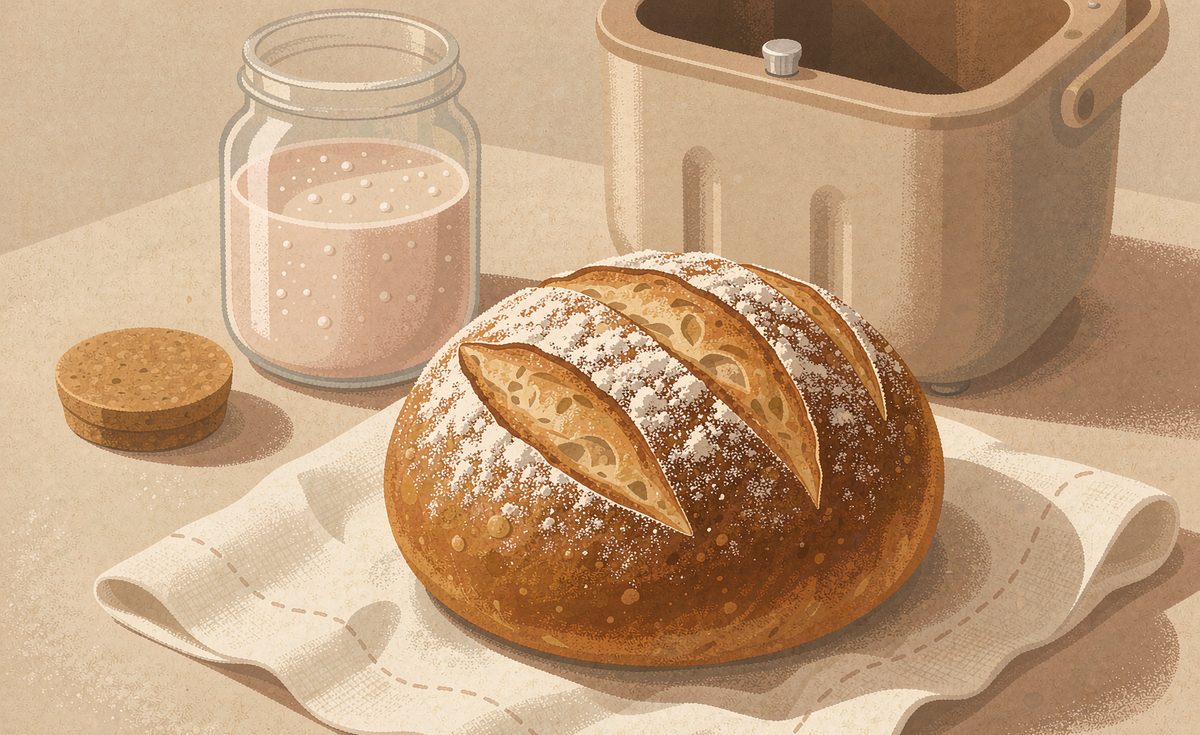
What a bread machine is genuinely good at (and bad at) for sourdough
| Good at | Bad at | |
|---|---|---|
| Kneading | Develops gluten thoroughly and consistently — better than most hand-kneading | — |
| Rising | Holds a stable warm temperature for predictable fermentation | Its rise windows are built for commercial yeast — too short for full sourdough bulk |
| Baking | Bakes a fully cooked, sandwich-friendly loaf | Soft pale crust, no scoring, fixed pan shape, paddle hole in the bottom |
Read that table again and the strategy writes itself: let the machine knead and rise; take over for the slow fermentation, shaping, and the bake. That's the hybrid method, and it's how experienced bakers use machines for sourdough.
Method 1 (recommended): the hybrid — machine dough cycle, oven finish
- Prep the starter. Feed your starter 4–12 hours ahead so it's active and bubbly. Quick test: drop a spoonful in water — if it floats, it's ready.
- Load the machine. Liquids first: 375 g lukewarm water, then 100 g active starter. Add 500 g bread flour on top, and 10 g salt in a corner, away from the starter's path. Select the dough cycle — not basic. (No dough cycle? A whole wheat or French cycle runs longer; use that.)
- Watch the first knead. At 5–10 minutes the dough should form a smooth, slightly tacky ball. Too stiff → add water a teaspoon at a time. Too sticky → add flour a teaspoon at a time.
- Let it bulk-ferment. Let the machine finish its cycle, then leave the dough in the pan for another 2–4 hours if it needs more rise — sourdough doesn't respect the timer. You want it noticeably puffy, not doubled-and-collapsed.
- Shape and proof. Tip the dough onto a floured surface, shape into a round or oval, and proof in a floured banneton or on parchment for 1–3 hours, covered.
- Bake with steam. Preheat your oven to 450°F with your Dutch oven inside. Score the loaf, bake covered 20 minutes, then uncovered 20–25 minutes until deep golden (internal 200–210°F). Cool completely — at least an hour — before slicing.
Why this wins: you get the machine's reliable kneading and warm rising environment, then real sourdough fermentation time, scoring, and a crackling Dutch-oven crust. It's the difference between "sourdough-ish sandwich bread" and bread worth the name.
Method 2: full machine bake — the convenient compromise
If you want a single-button loaf, it works — with expectations set correctly. You'll get a soft-crusted, sandwich-shaped sourdough loaf with a paddle hole, no scoring, and a milder tang than oven bread. Three adjustments make it succeed:
- Give it a boost. Add ~1 g (¼ tsp) of commercial yeast alongside the starter. The starter provides flavor; the yeast provides the rise the machine's short cycle expects. This is the standard workaround, not cheating.
- Use the longest cycle. Whole wheat or French cycles run longer than basic and give the dough more fermentation time. If your machine has a dedicated sourdough program (some premium models do), that's the one.
- Consider a cold ferment. Mix the dough by hand the night before with starter only, ferment it in the fridge overnight, then load it into the machine pan in the morning and run a bake-only cycle. True sourdough fermentation, machine convenience.
Method 3: machine as mixer only
The minimalist option: run the dough cycle for 15–20 minutes of kneading, stop the machine, remove the dough, and do everything else — bulk ferment, shape, proof, bake — by hand or in the oven. This is ideal if your kitchen is cold (the machine's warm cavity helps the rise) or if hand-kneading is hard on your joints. It's Method 1 without the machine doing the first rise.
What to expect from machine sourdough (honest results)
- Hybrid (Method 1): a genuinely good loaf — open-ish crumb, real crust, real tang. Closer to bakery sourdough than anything else on this page.
- Full machine (Method 2): a soft, mild, sandwich-style sourdough loaf. Good bread; not the crackly round you see in bakeries. For many households, that's exactly what they want — see our beginners guide for machines best suited to it.
- Cold-ferment + bake-only: the best flavor-per-effort of the machine methods — worth trying once you've got a rhythm.
One note on machines: sourdough benefits from the same features our reviews already weight — strong kneading and a whole wheat or French cycle. A dedicated sourdough program is a bonus, not a requirement. Our best bread maker shortlist and the Dutch oven guide cover both sides of the equation.
Tools that make machine sourdough easier
Scale + lame (scoring blade)
Sourdough is ratio-sensitive, and the hybrid method needs a scoring blade for the oven finish. Both are cheap, permanent kitchen tools — the scale also fixes every other bread machine recipe on this site.
Find a scale & lame on AmazonBanneton + Dutch oven
A floured banneton shapes and proofs the dough; a preheated Dutch oven supplies the steam that makes sourdough crust crackle. Our sourdough starter kit guide ranks the five tools in the order to buy them.
Check bannetons on AmazonFrequently asked questions
Does my bread machine need a sourdough setting?
No — a few premium machines include one, but the hybrid method (dough cycle + oven) works on any machine with a dough cycle. The machine's real contributions are kneading and warm rising, neither of which needs a special program.
Why is my machine sourdough flat or dense?
Almost always a starter or timing issue: a starter that's too young (feed it more), a basic cycle that rushed the fermentation (use the dough cycle and let it go longer), or dough that was too wet or dry for the pan (adjust during the first knead).
Can I use my sourdough starter in any bread machine recipe?
Not by direct substitution — starter adds flour, water, acid, and wild yeast all at once, so it changes hydration and timing. Use recipes written for sourdough in a machine, and weigh everything.
Is machine sourdough as good as hand-made sourdough?
For crust, crumb openness, and tang, the hybrid method gets close — the differences are small and mostly cosmetic. Full machine bakes trade those qualities for convenience, which is a fair trade if sandwich-style sourdough is the goal.
Next read: Best sourdough starter kits → · Best Dutch ovens for sourdough → · Whole wheat bread machine recipe →